
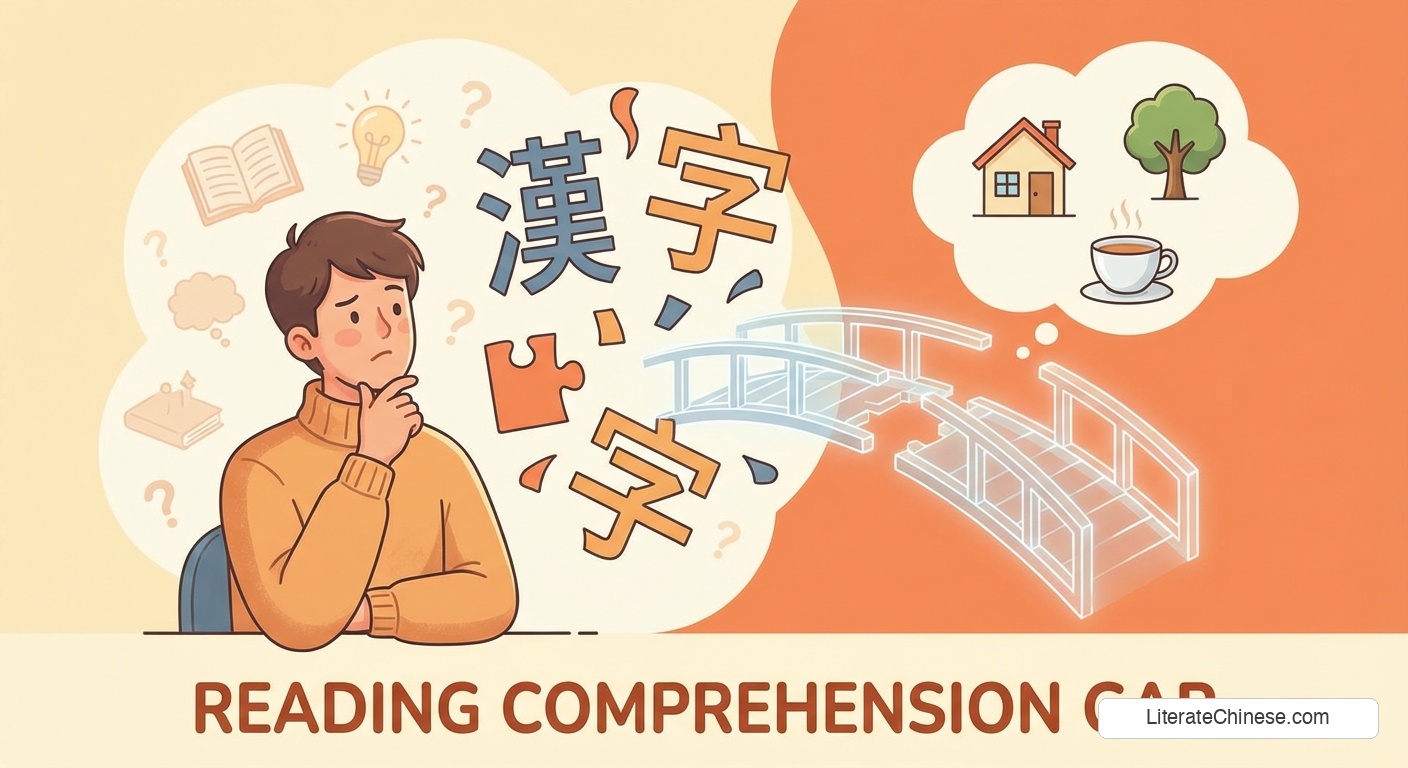
You've memorized 2,500 Chinese characters. You can identify them on flashcards with impressive speed. Yet when you open a Chinese novel or news article, something frustrating happens—the words you know somehow don't add up to meaning you understand.
You're not alone. This phenomenon affects thousands of adult Chinese learners, and it has nothing to do with how smart you are or how hard you're studying.
The Decoding vs. Comprehension Split
Research on second language reading has revealed something crucial: there's a fundamental difference between decoding (recognizing individual characters) and comprehension (understanding the overall meaning of text).
A study published in the journal Reading and Writing examined adult learners of Chinese and found that character recognition and reading comprehension are actually separate cognitive skills. Knowing a character doesn't automatically translate to understanding how that character functions in context.
This might sound obvious once you read it, but it explains why traditional study methods often leave learners in a strange middle ground. You can pass HSK 5 but still struggle with a children's book. You can name every character in a sentence but miss the point entirely.
Why This Gap Exists
Several factors create this comprehension gap for adult learners:
1. Character Learning in Isolation
Most vocabulary study presents characters in isolation or in decontextualized sentences. You learn that 学 means "to study" or "learning." But you rarely see it used across dozens of authentic contexts—academic studying, learning a skill, a student's studies, studying abroad. Each context subtly shifts the meaning and usage.
2. The Passive Vocabulary Problem
When you memorize vocabulary through flashcards, you're building passive recognition. But reading requires active retrieval under time pressure while simultaneously tracking the larger narrative or argument. That's a fundamentally different cognitive task.
Research on vocabulary acquisition shows that learners need multiple exposures across varied contexts before words become truly accessible for reading. Most study methods don't provide this natural repetition.
3. Missing Cultural and Contextual Knowledge
Chinese writing often assumes shared cultural knowledge. References to historical events, classical literature, or social norms may be invisible to learners who didn't grow up in Chinese-speaking environments. Even advanced students can miss meaning that a native speaker would catch instantly.
4. Processing Speed
Adult learners often decode character by character, which consumes cognitive resources needed for understanding the bigger picture. Native readers process entire phrases at once, freeing up mental bandwidth for comprehension. This automaticity only develops through massive amounts of reading practice.
The Heritage Speaker Complication
If you grew up in a Chinese-speaking family but were educated primarily in another language, you face a unique version of this challenge. Research on Chinese heritage language learners shows they often develop strong oral comprehension but struggle with printed vocabulary knowledge—the ability to recognize and understand characters in written text.
This happens because literacy develops differently from spoken language. You might understand your grandmother perfectly when she speaks, but the written form of her words uses vocabulary and structures you never encountered in daily conversation.
Heritage speakers often have the opposite problem from textbook learners: they have strong comprehension skills but gaps in character knowledge. Both groups end up frustrated, unable to read at the level their other skills would suggest.
What Actually Works
The solution isn't more flashcards or another vocabulary list. It's changing how you read.
Extensive Reading
Extensive reading means reading large quantities of material at a comfortable level—something you can understand with minimal dictionary lookups. The goal isn't to master every word but to build reading automaticity and expose your brain to Chinese in context.
Choose graded readers designed for learners, or find native content where you understand roughly 95% of the words. That might mean children's books, simple news articles, or learner-appropriate novels. The key is reading at volume—hundreds of pages, not just a few sentences.
Read Along with Audio
Pairing written text with audio helps bridge the comprehension gap. When you hear how native speakers pace their reading and inflect certain phrases, written Chinese becomes more accessible. This is particularly helpful for learners transitioning from textbook Chinese to authentic content.
Don't Lookup Every Word
When you encounter an unknown word, guess from context first. Then look it up. Then keep reading. This process—struggling slightly, getting help, continuing—builds the skill of reading in ways that fully guided study can't replicate.
One useful rule: if you can understand a page with fewer than 5-7 unknown words, keep reading. If there are more than that, the material is too difficult for extensive reading right now. Find something easier.
A Different Way to Think About Progress
Here's an insight worth considering: the goal isn't to learn all the vocabulary before you start reading. It's to read in order to acquire the vocabulary naturally.
When you read extensively, you're not just memorizing words—you're building the entire ecosystem around them. You learn which characters commonly appear together, how sentences flow, what phrases sound natural, and how ideas connect across paragraphs. These are things that flashcards simply can't teach.
This approach takes patience. You won't feel the immediate satisfaction of checking off a vocabulary list. But over months of consistent reading practice, something shifts. Characters that once required effort become automatic. Sentences that seemed dense become clear. And one day, you'll realize you're reading—not just decoding, but actually understanding—and enjoying it.
Ready to Start Reading in Chinese?
Literate Chinese provides free graded reading practice designed for adult learners. Our material ranges from beginner to intermediate, so you can find content that challenges you without overwhelming you.
Start Reading Practice →