
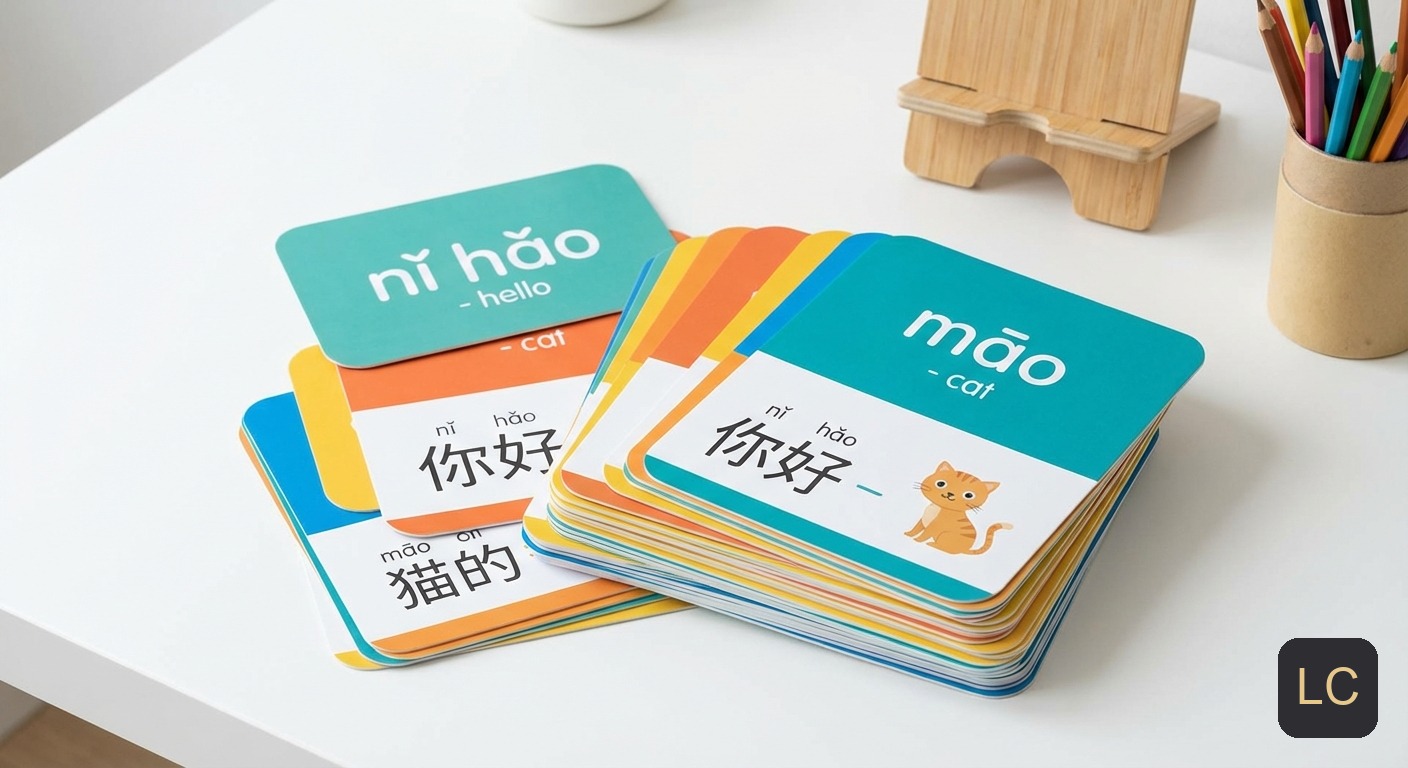
You've probably done this hundreds of times: you're reading a Chinese sentence, and your eyes instinctively dart to the pinyin above each character. You can sound out every word. But if someone covered up the romanization, you'd be lost.
This isn't a personal failing. It's an incredibly common phase that most Chinese learners go through—and one that many apps and textbooks deliberately keep you in.
The Pinyin Trap Is Built Into Most Learning Materials
Here's the thing: almost every Chinese learning app, from Du Chinese to Hack Chinese to the big name brands, uses pinyin as a scaffold. Stories are presented with pinyin annotations. Vocabulary lists show the romanization first. Even many "graded readers" never fully let go of the training wheels.
There's a good pedagogical reason for this. Pinyin helps beginners recognize sounds and build early confidence. But there's a darker reason too: it's easy to keep learnersdependent on a crutch. If you can always read the pinyin, you never really need to learn the characters. And that keeps people paying for subscriptions month after month.
The result? Learners who've studied for years who still can't read a simple Chinese text message without the romanization. They've memorized vocabulary through pinyin associations, which means the characters never become visually recognizable on their own.
Why Reading Characters Directly Matters
There's a fundamental difference between phonetic decoding (sounding out words) and visual recognition (seeing a character and knowing its meaning instantly). When you read in English, you don't sound out each letter—you recognize whole words. Chinese works the same way, except the "words" are characters.
Once you can read characters directly, several things change:
- Reading speed jumps dramatically. You're no longer doing double work: decoding pinyin, then mapping to meaning. You go straight to understanding.
- Vocabulary sticks better. Characters have semantic components. When you see 游泳 (yóuyǒng, swimming), you're seeing the water radical 氵plus the character for "long" 诵. It's a mnemonic, not just a random shape.
- You can use Chinese input methods. Typing in Chinese is nearly impossible if you're thinking in pinyin first. Direct character recognition makes typing natural.
- You can read without audio. No more needing headphones every time you want to read something. Real Chinese texts, signs, messages—all become accessible.
The Honest Truth About Transitioning
Making this shift isn't fun. It's genuinely uncomfortable for a while. You're giving up a system that works (even if slowly) for an unfamiliar one that feels slower at first. This is where most people plateau. They've reached a intermediate level where pinyin is automatic, but true character reading feels like starting over.
Working with learners over the years, I've seen this transition go two ways. The first is the crash-course approach: throw away all pinyin, force yourself to read only characters, suffer through the pain. It works for some people with strong discipline, but many burn out.
The second approach is gentler but more deliberate: gradually reduce pinyin support while building character recognition through high-volume reading. The key insight is that your brain needsmassive exposure to patterns before it automates recognition. You don't learn characters by studying them one at a time—you learn them by seeing them thousands of times in context.
A Practical Framework for Breaking Free
If you're ready to make the shift, here's what actually works:
1. Start With High-Frequency Characters
Don't try to learn every character. Focus on the 100-200 most common ones first. These appear in roughly 50-70% of most texts. Master these, and you can recognize half of any Chinese text with no pinyin at all.
2. Use Pinyin as a Safety Net, Not a Map
When you're reading, here's the practice: look at the character first. Try to recognize it. Then, and only then, check the pinyin if you need to. You're training your eyes to go to the character first, not the romanization.
3. Read at Your Level Without Training Wheels
Use graded readers that allow you to turn off pinyin. Read content where you're understanding 70-80% of words from context. This is called "extensive reading"—lots of material at the edge of your ability, where you can absorb patterns without constant translation.
4. Add Character Study Sessions
Dedicate 10-15 minutes daily to deliberate character learning. Focus on semantic components (radicals) and common phonetic elements. This builds the visual vocabulary that makes free reading possible.
What About Heritage Speakers?
If you grew up speaking Chinese at home, you might think this doesn't apply to you. But here's what I've noticed working with many heritage learners: speaking fluency doesn't translate to reading ability. You can hold a conversation in Mandarin but still struggle to read a news article.
This happens because spoken Chinese and written Chinese use different vocabularies and structures. The transition is actually even more important for heritage speakers—it's what takes you from "I can talk to my grandmother" to "I can read what she wants to tell me."
Heritage speakers have a secret advantage too: they already have the sounds in their heads. They don't need pinyin for pronunciation. It's just a matter of connecting those familiar sounds to the written forms.
The Bigger Picture
Breaking pinyin dependency isn't just about reading faster. It's about joining the world of Chinese文字 (wénzì)—the actual written language that hundreds of millions of people use every day. It's about reading messages from family, understanding signs, enjoying novels, and accessing Chinese internet content without a mediation layer.
The apps that compete on being "easy" keep you in the shallow end. The apps that challenge you to go character-first are the ones that actually get you somewhere.
Ready to Try Reading Without Pinyin?
We've built our reading practice system to let you gradually reduce pinyin support—starting with character-first displays and building up to pure Chinese text. It's free to try.
Start Reading Practice