
Chinese Graded Readers
Graded readers are the single most effective tool for learning to actually read Chinese. The idea is simple: stories written so that you already know nearly every word, keeping you in the sweet spot where reading feels like reading — not like decoding. You pick up new words from context, grammar patterns start to feel natural instead of memorized, and characters you've studied finally stick because you keep meeting them in sentences that matter.
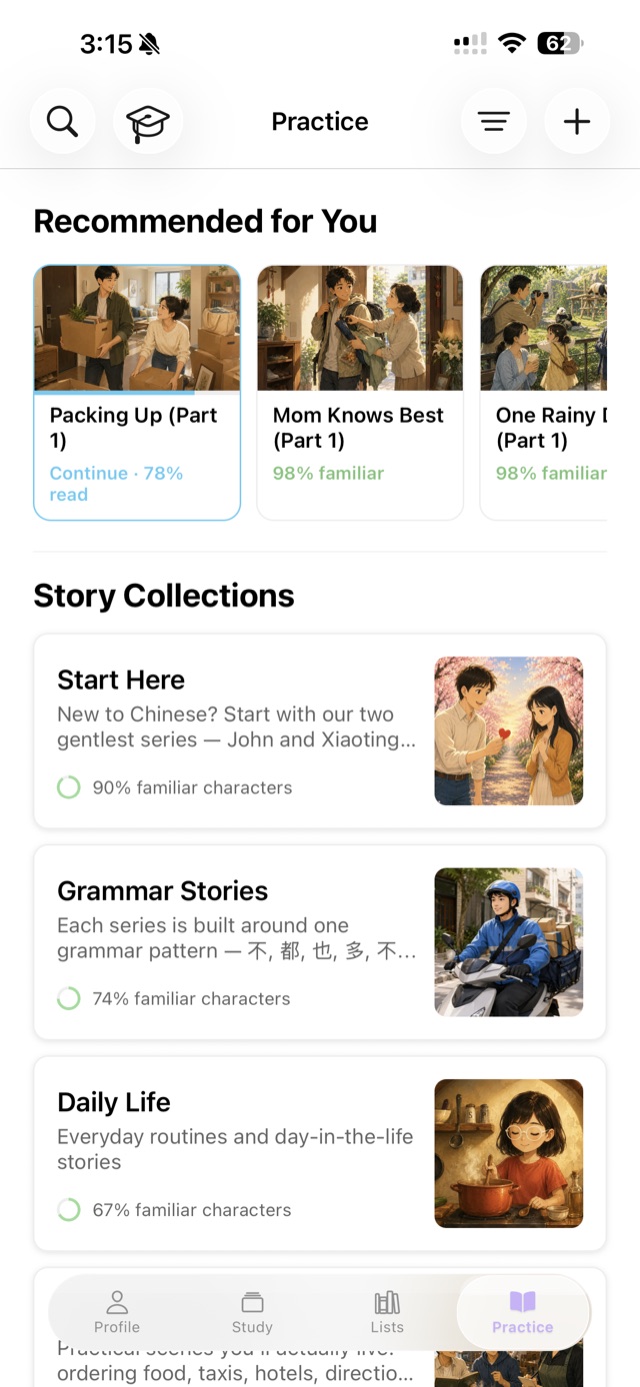
Literate Chinese is a library of 1,000+ Chinese graded readers — from absolute-beginner dialogues written with a few dozen characters to adapted Chinese classics — with a difficulty system no paper series can match: every story shows a familiarity percentage based on the exact characters you know, because the app tracks every word you've studied.
Why graded readers beat textbooks (and native content)
Textbook dialogues are too short to build reading stamina, and native content — novels, news, social media — is brutally far away for most learners: a typical web novel assumes 2,500+ characters. Graded readers bridge that gap. Reading large amounts of Chinese you mostly understand (often called comprehensible input) is how vocabulary moves from "studied it once" to "just know it." The research rule of thumb is to read material where you know about 98% of the words — challenging enough to learn from, easy enough to enjoy.
The catch with traditional paper graded readers: they're written to a fixed word list that is never quite your word list, you can't look anything up without breaking flow, and at $10–15 per thin volume, reading widely gets expensive.
A library that grows with you
- Absolute beginner: gentle series like John and Xiaoting and Kitten & Puppy Adventures, written for your first hundred characters — completely free.
- Beginner: grammar-pattern series and day-in-the-life stories that recycle high-frequency vocabulary until it's automatic.
- Elementary: daily-life scenes you'll actually live — ordering food, taxis, hotels, small talk — plus classic fables.
- Intermediate: Chinese idiom stories (成语), business and startup series, historical figures, and multi-part serials.
- Advanced: adapted classics — Journey to the West, 聊斋 strange tales, O. Henry — and long-form stories approaching native difficulty.
Every story has tap-to-look-up on every word (pinyin, meaning, audio), sentence translations, native-quality narration, and one-tap flashcard creation for words you want to keep. Finish a story and the app credits every word you met toward your vocabulary — reading itself makes the rest of the library easier.
Start reading right now
How to use graded readers
The method that works is extensive reading: pick material easy enough that you understand about 98% of the words, read a lot of it without stopping to study, and move up a level only when the current one feels effortless. Most learners do the opposite, choosing texts that are too hard and dissecting them line by line. That is intensive reading, and it has a place, but it does not build fluent readers.
- Aim for about 98% comprehension. Hu and Nation's 2000 study found comprehension collapses as unknown words pass roughly one in twenty. One unknown word in fifty is where context teaches you.
- Test the text, not the label. Read about 100 characters. Two or fewer unknown words: good extensive material. Three to five: slower study material. More: shelve it for now.
- Move up when a level feels easy, not merely possible. Read several books or a few dozen short stories per level. Speed is the tell: when you read noticeably faster and unknown words are rare, go up.
- Re-read and listen while reading. A second pass is 100%-coverage input, and audio pins every character to its sound and tone, which matters more in Chinese than in most languages.
- Fifteen minutes daily beats a two-hour Sunday. Track minutes read, not words learned. Volume is the active ingredient.
Character knowledge compounds. Across the 658 graded stories in the Literate Chinese catalog, knowing the 500 most frequent characters makes 60 stories 98% readable, 1,000 makes 330 readable, and 1,500 makes 563. Every character you learn buys more than the last one did. See how many characters you need to read Chinese and intensive vs extensive reading for the full argument.
Common questions
What is a Chinese graded reader?
A story written with a deliberately limited vocabulary so learners can read it comfortably. You learn fastest when you already know roughly 98% of the words on the page — graded readers keep you in that zone while your vocabulary grows.
Are these graded readers free?
Nearly 400 of the 1,000+ stories are free in the app, including complete absolute-beginner series — and there are 90+ stories you can read free in your browser with no account at all. Premium unlocks the full library.
Do the stories support Traditional characters and zhuyin?
Yes — every story can be read in Simplified or Traditional, with pinyin or zhuyin (bopomofo), Mainland or Taiwan audio, and vocabulary that adapts to regional usage. There’s a dedicated traditional Chinese reading practice page with free browser stories.
What level do I need to start?
None. The gentlest series are written for complete beginners, and every story shows a familiarity percentage based on the characters you actually know, so you always know what's readable.