
Chinese Reading Practice for Beginners
You can read real Chinese in your first week. This is a hand-picked path of 15 short stories, in order, from four-line dialogues to your first whole scenes — 879 characters of reading in all, with pinyin and English one tap away.
- 15stories, in order
- 4weeks at a gentle pace
- 26–156characters per story
- 68more HSK 1–2 stories after
Start here: how this path works
Most beginner "reading practice" is either a word list in disguise or a story that's three levels too hard. This path is different: it starts with dialogues so short you can read them on your first day — 29 characters — and adds one new idea per story. By the last one you are reading a 156-character scene with a plot. Every story runs in your browser with pinyin, English sentence translations and tap-to-look-up.
- 15 stories in order, about four a week — one a day with rereads.
- Weeks 1–2: short dialogues (self-introductions, 是/有/吗, numbers, 很 + adjective).
- Weeks 3–4: narration and whole little scenes (喜欢, 在, 了, quoted speech).
- Then: all 28 HSK 1 stories, then 40 HSK 2 stories.

Story 1: read it right now
Turn on Pinyin above if you need it, tap any word for its meaning, and use Translation to check yourself. Then do it again with pinyin off — that second read is the real practice.
小婷:你好!你是约翰吗?Xiaoting: Hello! Are you John?
约翰:是的,我是约翰。John: Yes, I am John.
小婷:你好,约翰!Xiaoting: Hello, John!
约翰:你好,小婷!John: Hello, Xiaoting!
The 15-story beginner path
Follow it in order. Each story notes the one new thing it introduces, so you know what to look for.
Week 1 Say who you are
Four tiny dialogues, about 30 characters each. Read each one three times: pinyin on, pinyin off, then out loud.
- 1I Am John小婷:你好!你是约翰吗?约翰:是的,我是约翰…Your first question: 你是…吗? and the answer 是的.
- 2What's Your Name?小婷:你好!你叫什么?约翰:我叫约翰。你叫什…Names with 叫 and the question word 什么.
- 3Are You a Teacher?小婷:你好,约翰!你是老师吗?约翰:不,我不…Saying no with 不: 我不是老师,我是学生。
- 4Do You Have a Book?约翰:你好,小婷!你有书吗?小婷:我有书。你…有 for "have", and asking 你有…吗?
Week 2 People, numbers and feelings
Still short dialogues, but now with numbers, family words and adjectives.
- 5How Old Are You?小婷:约翰,你多大?约翰:我二十岁。你呢?小…Numbers and ages, plus the bounce-back question 你呢?
- 6This Is My Mom小婷:约翰,这是我妈妈。约翰:你好!妈妈:你…Introducing people with 这是….
- 7Are You Okay?约翰:你好,小婷!你好吗?小婷:我很好。你好…很 + adjective: how 我很好 really works.
- 8I Love Dogs约翰:你好,小婷!你爱狗吗?小婷:你好,约翰…Likes and loves with 爱, still all in dialogue.
Week 3 From dialogue to story
Narration starts: someone does something, someone else reacts. 50–70 characters each.
- 9
 The Kitten and the Puppy这是小猫。这是小狗。小猫很小,很漂亮。小狗也…Your first narration instead of dialogue: 这是…, 也, 可爱.
 - 10The Kitten Likes Fish, the Puppy Likes Meat今天,小猫吃鱼。小猫很高兴。小狗说:“鱼不好…喜欢 + verb, and quoted speech with 说:“…”
- 11Playing Ball Together天气很好。小狗在外面玩球。小猫看见了,说…在 + verb for what is happening now; 想 for wanting.
- 12
 Lil Jon Eats Breakfast妈妈做了煎饼。她问小约翰:你想吃煎饼吗?小约…了 after a verb (做了) — and a very patient mom.
Week 4 Whole little scenes
Multi-paragraph stories of 110–200 characters — the size of a real graded-reader page.
- 13
 Ordering at a Restaurant (Part 1)中午,李明和朋友走进一家小餐厅。服务员说…欢迎光临, 几位, 菜单: the words you hear on day one in China or Taiwan.
 - 14
 Let's Go See the Sea! (Part 1)约翰:小婷,我们去旅行吧!小婷:好啊!去哪儿…Suggestions with 吧 and the start of a two-part trip.
 - 15
 A Box at the Door (Part 1)早上,门口有一个大箱子。小雨问:“这是什么…A real plot in four short paragraphs. Something in the box says hello.
Your first month of reading Chinese: 8 tips
- Learn pinyin first, briefly. A few days with how to read pinyin is enough. Tones matter more than perfect spelling.
- Read every story three times. Pinyin on, pinyin off, then out loud. Rereading is not cheating; it is how reading speed is built.
- Tap, don't translate. Tap a word only when the sentence stops making sense. Guessing from context is a skill you are training too.
- Keep it short and daily. Ten minutes a day beats an hour on Sunday. The path is sized for one story a day with rereads.
- Collect words you keep meeting. If a word turns up in three stories, it's worth a flashcard. Start with the HSK 1 word list.
- Pick a script and stay with it for a month. Simplified for Mainland China, traditional for Taiwan and Hong Kong. The 简/繁 switch on every story remembers your choice.
- Expect the plateau in week 3. When dialogue turns into narration, stories feel harder for a few days. That's the point where reading starts to pay off.
- Measure progress by rereading. Go back to story 1 at the end of the month. It will feel trivially easy — that is your progress, made visible.
Key HSK 1 words in these stories
These are the HSK 1 words (HSK 3.0 list) that turn up most often across the stories on this page, so they are the ones worth knowing before you start — you'll see each of them again and again. Browse the full HSK 1 word list for everything else.
- 我wǒIin 12 of 15 stories
- 好hǎogoodin 10 of 15 stories
- 很hěnveryin 10 of 15 stories
- 吗嗎ma(question particle)in 9 of 15 stories
- 你nǐyouin 8 of 15 stories
- 是shìto bein 7 of 15 stories
- 他们他們tā mentheyin 5 of 15 stories
- 想xiǎngto thinkin 5 of 15 stories
- 朋友péng youfriendin 5 of 15 stories
- 说說shuōto speakin 5 of 15 stories
- 什么什麼shén mewhatin 4 of 15 stories
- 我们我們wǒ menwein 4 of 15 stories
- 了le(particle indicating completed action or change in 4 of 15 stories
- 不bùnoin 3 of 15 stories
- 这這zhèthisin 3 of 15 stories
- 妈妈媽媽mā mamomin 3 of 15 stories
Hear every story while you read
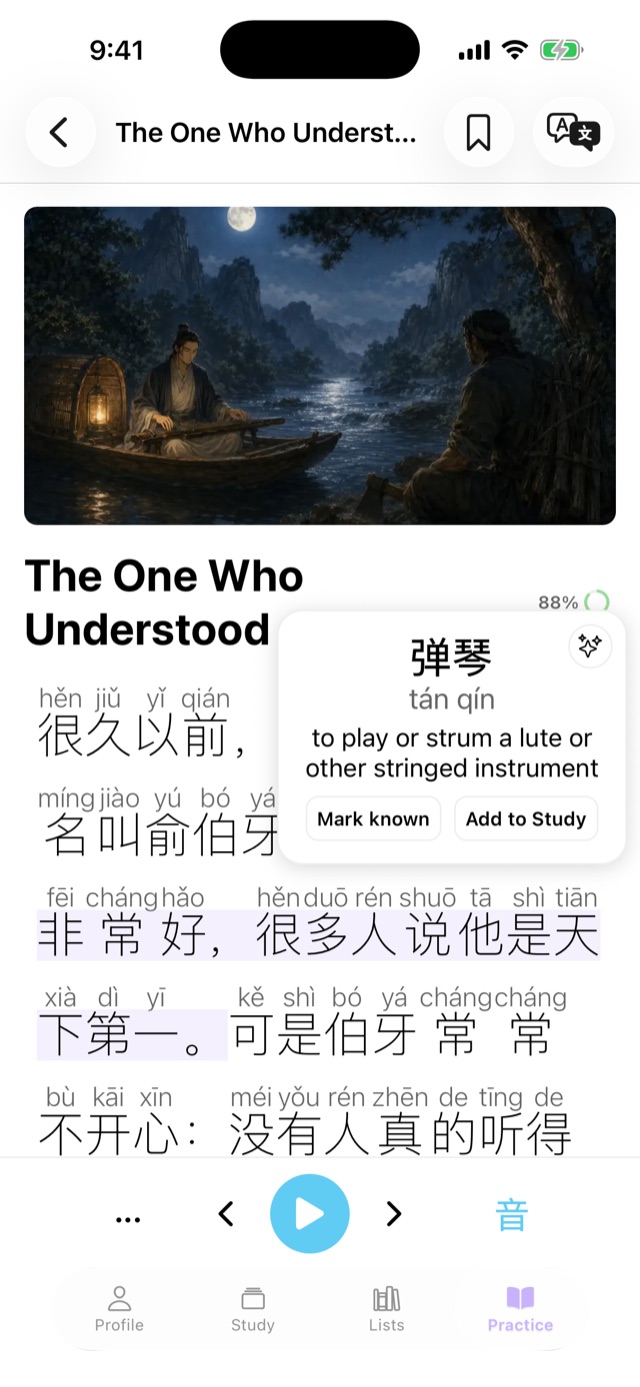
In the Literate Chinese app, every one of these stories is narrated by native speakers — choose Mainland or Taiwan Mandarin — and the words you tap become flashcards automatically.
It also matches stories to the exact words you know, so after this path it can point you at the next ones that fit — out of 1,000+ graded stories, including 42 more at the HSK 1 level that aren't on the web.


Frequently asked questions
Can I read Chinese as a complete beginner?
Yes, if the text is graded. The first story on this path is 29 characters long and uses words like 你好, 是 and 吗 that most learners meet in lesson one. Pinyin is printed over every word when you switch it on, so you can read before you know the characters.
Should beginners read with pinyin?
Use it, but don't live in it. Read each story once with pinyin to get the sounds, then again with pinyin off so your eyes go to the characters. Many learners find the second read is where characters start to stick.
How many characters do I need to start reading Chinese?
Fewer than you think. The first story here uses 10 different characters, and the whole 15-story path uses 187. The HSK 1 list of the 2026 HSK 3.0 syllabus (300 words, 248 characters) covers most of what our HSK 1 stories use.
How long until I can read a real story?
With a story a day, about a month: week 4 of this path is already multi-paragraph stories with a plot. After that, the HSK 1 and HSK 2 lists give you over a hundred more.
Also useful: Not sure of your level? Take the 2-minute character test · How to read pinyin · Traditional reading practice · How graded readers work